 Add to Chrome
 Add to Firefox
 Add to Edge
Learning Abstractions for Hierarchical Planning in Program-Synthesis Agents
Jan 31, 2026
Humans learn abstractions and use them to plan efficiently to quickly generalize across tasks -- an ability that remains challenging for state-of-the-art large language model (LLM) agents and deep reinforcement learning (RL) systems. Inspired by the cognitive science of how people form abstractions and intuitive theories of their world knowledge, Theory-Based RL (TBRL) systems, such as TheoryCoder, exhibit strong generalization through effective use of abstractions. However, they heavily rely on human-provided abstractions and sidestep the abstraction-learning problem. We introduce TheoryCoder-2, a new TBRL agent that leverages LLMs' in-context learning ability to actively learn reusable abstractions rather than relying on hand-specified ones, by synthesizing abstractions from experience and integrating them into a hierarchical planning process. We conduct experiments on diverse environments, including BabyAI, Minihack and VGDL games like Sokoban. We find that TheoryCoder-2 is significantly more sample-efficient than baseline LLM agents augmented with classical planning domain construction, reasoning-based planning, and prior program-synthesis agents such as WorldCoder. TheoryCoder-2 is able to solve complex tasks that the baselines fail, while only requiring minimal human prompts, unlike prior TBRL systems.

Synthesizing world models for bilevel planning
Mar 26, 2025Modern reinforcement learning (RL) systems have demonstrated remarkable capabilities in complex environments, such as video games. However, they still fall short of achieving human-like sample efficiency and adaptability when learning new domains. Theory-based reinforcement learning (TBRL) is an algorithmic framework specifically designed to address this gap. Modeled on cognitive theories, TBRL leverages structured, causal world models - "theories" - as forward simulators for use in planning, generalization and exploration. Although current TBRL systems provide compelling explanations of how humans learn to play video games, they face several technical limitations: their theory languages are restrictive, and their planning algorithms are not scalable. To address these challenges, we introduce TheoryCoder, an instantiation of TBRL that exploits hierarchical representations of theories and efficient program synthesis methods for more powerful learning and planning. TheoryCoder equips agents with general-purpose abstractions (e.g., "move to"), which are then grounded in a particular environment by learning a low-level transition model (a Python program synthesized from observations by a large language model). A bilevel planning algorithm can exploit this hierarchical structure to solve large domains. We demonstrate that this approach can be successfully applied to diverse and challenging grid-world games, where approaches based on directly synthesizing a policy perform poorly. Ablation studies demonstrate the benefits of using hierarchical abstractions.
Modeling human intuitions about liquid flow with particle-based simulation
Sep 05, 2018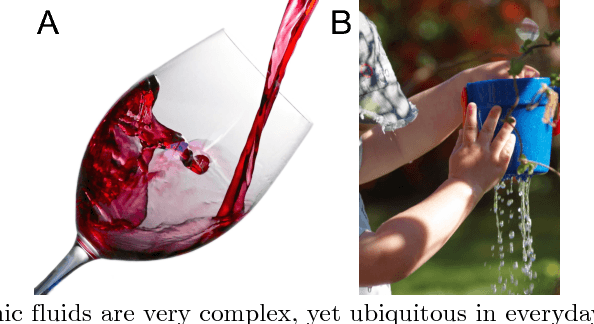
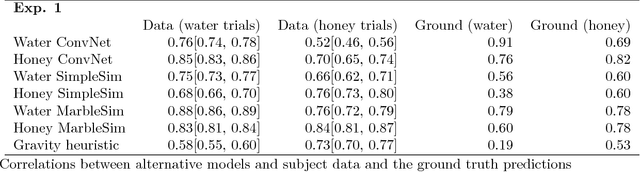
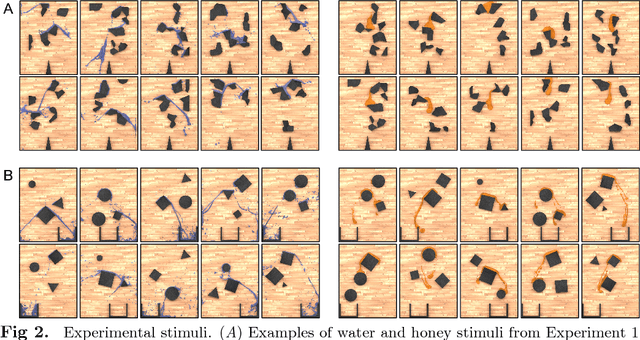
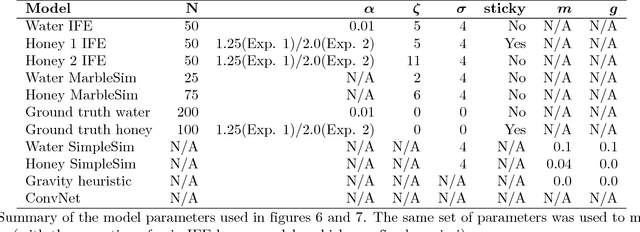
Humans can easily describe, imagine, and, crucially, predict a wide variety of behaviors of liquids--splashing, squirting, gushing, sloshing, soaking, dripping, draining, trickling, pooling, and pouring--despite tremendous variability in their material and dynamical properties. Here we propose and test a computational model of how people perceive and predict these liquid dynamics, based on coarse approximate simulations of fluids as collections of interacting particles. Our model is analogous to a "game engine in the head", drawing on techniques for interactive simulations (as in video games) that optimize for efficiency and natural appearance rather than physical accuracy. In two behavioral experiments, we found that the model accurately captured people's predictions about how liquids flow among complex solid obstacles, and was significantly better than two alternatives based on simple heuristics and deep neural networks. Our model was also able to explain how people's predictions varied as a function of the liquids' properties (e.g., viscosity and stickiness). Together, the model and empirical results extend the recent proposal that human physical scene understanding for the dynamics of rigid, solid objects can be supported by approximate probabilistic simulation, to the more complex and unexplored domain of fluid dynamics.